
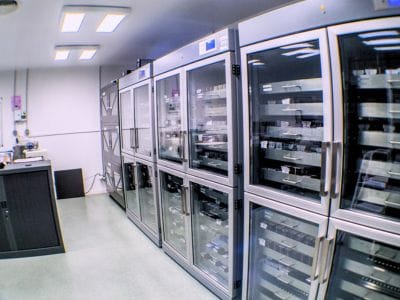
Storage of components

Objectives

  • Be able to identify acceptable requirements for different types of storage.
  • Understand and make decisions when setting up short-term, medium-term, or long-term storage (obsolescence strategy).

CONTEXTE

  • The product life cycle, sensitivity and failure mechanisms of stored entities, durability, and obsolescence are the key themes of the training.

INTRODUCTION

  • Stock and storage
  • Components and assembled boards
  • Obsolescence

FAILURE MECHANISMS

  • Mechanical stresses
  • Chemical stresses/effects of humidity
  • Electrostatic fields
  • Thermomechanic stresses
  • Other (dustiness)

STORAGE METHODS

  • Procurement
    • Sizing: Determines what needs to be stored and the necessary quantity required for Through-Life Support (TLS).
    • Packaging: Adapted to the storage requirements to be defined.
  • Reception control
    • Traceability: Recording the identity of the components.
    • Regulatory, Normative, or Requirement Compliance: Ensures adherence to applicable standards.
  • Initial technical validation : Validates the reliability of the incoming batch
    • Physical validation
    • Electrical validation
    • Reliability assessment
  • Storage under adapted conditions
    • In a dedicated location:
      • In cabinets or;
      • Under nitrogen,
      • In vacuum or dry air,
      • Under nitrogen, etc.
  • Periodic technical Validation
    • Detect potential degradation
  • Destocking without dusturbing initial storage conditions
    • Properly organize:
      • Logistics
      • Management (packaging, repackaging)
  • Exit technical validation
    • Detect any final degradation.
    • Pay attention to handling:
      • Tools
      • Component sensitivity

CONCLUSION

  • The implemented storage project ensures:
    • Availability,
    • Durability of the entity (in forecasted production or during its Through-Life Support), and
    • Provides guarantee and stability in safeguarding and maintaining the sustainability of the service.

Basic knowledge in component physics

Any persons working with component or circuit board storage

AQC (quality control) Engineer/Project Manager

Projected PowerPoint presentation, practical case study, exercises, situational examples, theoretical example, etc.

Assessments at the beginning and end of the course, quizzes, etc.

5 working days before the course start date (if financed by OPCO)

Qualiopi 2025 :

  • Satisfaction rate: 83%
  • Number of sessions: 3
  • Number of trainees: 11

AMONG OUR TRAINING

IOT Cybersecurity and RED Directive compliance

Vérification UVM UVM verification methodology awarness

UVM verification methodology awarness

Contact us